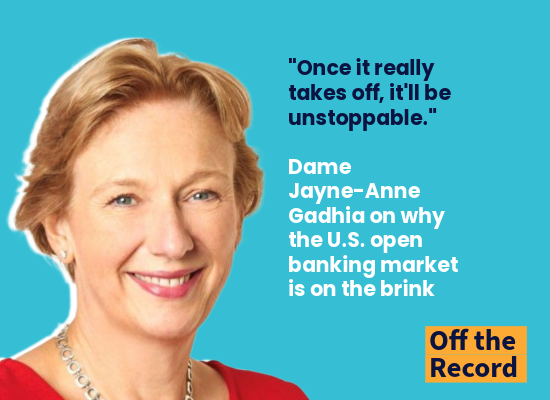
During our podcast episode, Off the Record: Huw Davies and Jayne-Anne Gadhia on Global Open Finance, the conversation turned to one of the biggest open banking markets in the world: the United States.
It’s a market that’s been shaped by innovation rather than regulation, where the world’s largest financial institutions are now making moves that could redefine open banking economics globally. And it’s a market where, despite being a tech powerhouse, open banking progress has been slower than many expected.
Dame Jayne-Anne, Ex-CEO of Virgin Money, shared her perspective with us on what’s happening in the U.S., why it’s taken longer to get going, and howg it’s only a matter of time before it becomes unstoppable.
A Market-Driven Approach, Now Facing Change
The U.S. open banking landscape has always been different. Unlike the UK or Europe, where regulation drove adoption from the start, the U.S. market has been largely shaped by innovation and market forces without regulatory mandates. Until now.
While the U.S. sits in what Huw Davies, CEO and Co-Founder at Ozone API, described as “a bit of a holding pattern,” something significant has shifted. The door has opened to what he calls “a real big move in the market” where JP Morgan has begun charging for access to their APIs.
“It has really changed the seriousness of the commercialisation conversation,” Huw explained.
It’s a move that has sparked intense debate across the industry, and Huw was keen to get Dame Jayne-Anne’s, perspective on it.
So how does she feel about it? Is it sustainable? Could it be a catalyst for broader market discussion?
The Fairness Question
Dame Jayne-Anne’s response was measured and practical.
“I wouldn’t want my bank to charge for my information, because I think it’s mine,” she began. “On the other hand, when I saw that, I thought it was fair enough, it does cost the bank to put in place these APIs. And we know the bigger the bank the more complex the systems, and presumably, the more expensive that is. And so to cover that particular cost, to cover that particular environment, I’m sort of okay with that. It seems fair, and fairness is important here.”
It’s a nuanced position that acknowledges both sides of the debate: data should belong to customers, but there are real costs involved in building and maintaining the infrastructure that makes data sharing possible.
Why the U.S. Has Been Slower to Adopt
But why has the U.S., a global leader in technology, been behind when it comes to open banking and financial data sharing?
Dame Jayne-Anne believes it comes down to the nature of the American banking market itself.
“In the US, it’s odd that they’re leading the world in terms of tech, but that they’re sort of behind in terms of data and financial services, and I suspect it’s because the state of the financial services market is very different to what it is in the UK.”
She pointed to a key cultural difference: “People in the U.S. tend to have a more personal relationship with their banks, so there’s a different relationship with the customer and their banks. It can be more local, it can be more personal, and I suspect that’s one of the reasons it’s taken longer to take off.”
That personal connection has meant less pressure for change. But it has also meant the same resistance to data sharing that she witnessed in the UK during the early days of open banking.
“The same way I described a CEO in the UK saying ‘it’s our data, it’s outrageous anyone wants to take it from us.’ That has happened in the US, and I think Jamie Dimon’s intervention is probably a way of trying to navigate that particular difficulty.”
Data Ownership as a Human Right
Despite the slower start, Dame Jayne-Anne is clear about where this is heading.
“My own view is that, it is only a matter of time until U.S. customers are saying ‘well hang on a second, I can now see that making available my data, in a way that’s going to facilitate my life and make me better off is almost a human right’. I think it’s a really really important thing that my data belongs to me.”
It’s the same fundamental shift that powered open banking in the UK: customers realising that their data, when shared securely and with their consent, can work for them rather than just for their bank.
And once that realisation takes hold?
“I think it’s a bit behind in the US, but once it really takes off, it’ll be unstoppable.”
Conclusion
The U.S. open banking market is at an inflection point. What started as a market-driven ecosystem is now facing regulatory change, and major players like JP Morgan are testing new commercial models that could reshape the economics of data sharing globally.
The question of who pays for open banking infrastructure is far from settled. But as Dame Jayne-Anne points out, fairness has to be part of the conversation. Banks have real costs, and customers have real rights over their data.
What’s clear is that the U.S. won’t stay in its holding pattern forever. The market is too large, the potential too significant, and once American consumers fully grasp the power of controlling their own financial data, the momentum will be impossible to stop.
The U.S. may have been slower to start, but when it does take off, it could redefine open banking on a global scale.
Want to hear more from Huw and Dame Jayne-Anne on the future of global open finance? Watch the full episode here.

 Shannon Bellringer