Open Insurance: An Era of Transparency and Customer-Centricity


Written by Rajesh Chawan
The insurance industry, a cornerstone of financial stability and security for centuries, is currently witnessing one of its most profound shifts – the transition towards ‘open insurance’. Rooted in the broader movement towards open banking and data democratisation, open insurance promotes transparency and customer-centricity, leading to better, more personalised insurance services.
In traditional insurance models, policy premiums and coverage are determined based on a customer’s profile – including aspects like medical history, job, salary, and educational details. Each insurance provider uses their proprietary algorithms and risk assessment models to do this. However, the customer often has little insight into how these variables influence their insurance terms.
Open insurance revolutionises this approach. The customer’s data, once exclusively held by individual insurers, can be shared with third-party providers (TPPs) with the customer’s consent. Data is no longer confined to the walls of a single insurance provider but can be harnessed by multiple entities to drive better, more customer-friendly services.
Taking the Brazil open insurance framework as an example, we can discern four key benefits this pioneering model offers:
To summarise, the Brazil open insurance framework exemplifies the power of data democratisation, heralding a more consumer-centric, transparent, and innovative era in the insurance industry. It transforms consumers from passive policyholders into active participants, empowering them with insights and control over their insurance decisions. As we move further into the era of open insurance, it will be intriguing to see how this trend continues to redefine the insurance services landscape globally.

Canada's Consumer-Driven Banking Act received Royal Assent on March 26th. Eyal Sivan, GM for North America at Ozone API and host of the Mr. Open Banking podcast, breaks down what the legislation actually settles, where Canada sits relative to other markets, and what banks and credit unions should be doing right now.
 Eyal Sivan
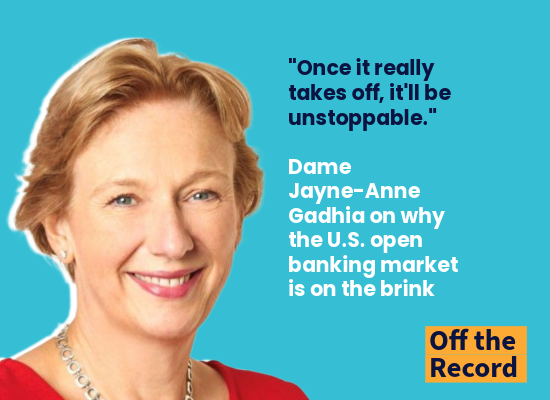
The U.S. open banking market has always moved on its own terms. But with JP Morgan now charging for API access, the commercial conversation has changed. Dame Jayne-Anne Gadhia, Ex-CEO of Virgin Money, joins Huw Davies to discuss data ownership, fairness, and why the U.S. won't stay in its holding pattern much longer.
 Shannon Bellringer

The traditional banking model is dead. Today's customers are CEOs of their own financial lives, assembling best-of-breed services through open finance. Banks face a critical choice: become a compliance-only utility and lose the customer interface, or build smart API strategies that make them indispensable components in customer-managed financial stacks.
 Fabio Caldeira