Key Takeaways from FDX Global Summit 2026 with Chris Michael
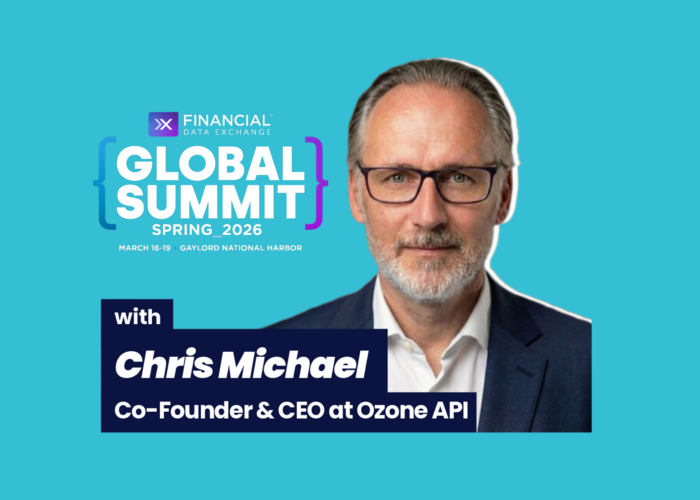

The FDX Global Summit brought together some of the sharpest minds in open finance this year, including our very own Co-Founder and CEO Chris Michael. One theme stood out above all others: digital assets and their relationship to open finance standards.
Here’s what Chris observed at the summit, in his own words.
The shift is already underway. Chris noted that, “Many banks, in the U.S. and globally, are starting to include both tokenized deposits and stablecoins products, since there are very significant benefits for their customers.” This isn’t a distant trend. Financial institutions are responding to where their customers actually are.
The case for including digital assets in financial planning isn’t theoretical. It’s practical, and it’s urgent: “More and more customers are holding a significant portion of their assets in these now, and there are clear use cases for including these as part of a customer’s credit assessment when applying for a loan or mortgage and in their financial planning to help with overall wealth management.”
Credit assessments and wealth management that ignore digital asset holdings are working with an incomplete picture. That’s a problem for customers, and for financial institutions that want to serve them well.
This is where the gap becomes obvious: “Open finance can help unlock both of these use cases. However, none of the major open finance standards globally currently cater for digital assets, neither as a read API (to allow the customer to share data in real time) nor as a write API (to allow the customer to move money to/from these assets).”
No read APIs. No write APIs. The infrastructure to support these use cases within open finance simply doesn’t exist yet.
There are obstacles to building it, but they shouldn’t be treated as blockers: “There are some technical challenges, especially related to: the lack of standardisation of data models across different asset types, and gaining access to encrypted data when stored in a public blockchain. But both are solvable.”
This is an important framing. The problems are specific, and specificity is what makes them addressable.
Building a standard that works will take more than FDX alone. “To create an open finance standard for digital assets will require collaboration with global providers who may not be FDX members. While FDX will be a key player in this space, the standard may be best developed in conjunction with other standards bodies who are also looking at this globally and/or specifically in other markets.”
No single body can own this. The more important goal is getting it right, which means bringing the right people to the table, wherever they are.
Geography matters here. Regulatory environment matters. “Markets such as the UAE, have dedicated regulators for digital assets, and may be moving more quickly to extend open finance in this direction.”
This is worth watching closely. Early movers in markets like the UAE will shape what good looks like for everyone else.
Chris’s closing thought from the summit is the one that matters most for the industry to hear:
“Extending open finance standards to cover digital assets and stablecoins will deliver real benefit for end customers as well as the FS sector as a whole. But we will be missing a trick if we don’t approach this with a global view, rather than developing different standards in each market.”
Fragmentation is the enemy of interoperability. If the financial sector arrives at this inflection point and produces a dozen competing regional standards, the potential of open finance for digital assets will be significantly reduced. The window to get this right, together, is now.
Want to catch up on the full panel that Chris spoke on at the FDX Global Summit? Watch below:

Open banking revenue models are the commercial frameworks banks use to generate income from their open banking infrastructure, beyond the regulated minimum of free API access for licensed third parties. Regulation sets the foundation. What a bank builds above that base, and how it prices it, is what determines whether open banking becomes a cost...
 Phoebe Singer

Los bancos argentinos llevaban tiempo esperando saber qué les exigiría concretamente el esquema de Finanzas Abiertas (Open Finance). Esa espera concluyó con la emisión del Decreto 353/2025 en mayo de 2025. En la práctica, este decreto ubica a la Argentina en la misma senda regulatoria que los regímenes de Open Banking a nivel internacional. Aunque...
 Fabio Caldeira
The Next Phase of KSA Open Banking Under the leadership of the Saudi Central Bank (SAMA), the Kingdom of Saudi Arabia continues to advance its Open Banking Framework as a core component of Vision 2030’s digital transformation agenda. Following the rollout of Account Information Services (AIS), the market is entering its next critical evolution: Payment...