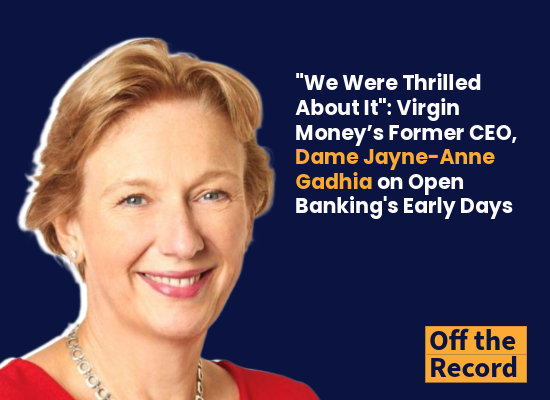
During our podcast episode Off the Record: Huw Davies and Jayne-Anne Gadhia on Global Open Finance, Dame Jayne-Anne shares her first-hand experience of what it was like to be right at the heart of the UK’s open banking revolution.
As CEO of Virgin Money during those early days, she witnessed the regulatory push for competition, the stubborn reality of consumer behaviour and the fundamental question at the centre of it all: who should own and control customer data?
In this conversation, she explains why challenger banks like Virgin Money saw open banking as an opportunity rather than a threat, why measuring success by account switching misses the point entirely, and why — despite claims to the contrary — open banking is far from a failure.
She was CEO of a well established bank in the UK just as open banking was kicking off. So how did she view it? Was it a good thing? A threat?
Competition, Not Disruption
Dame Jayne-Anne absolutely saw open banking as a good thing.
“Throughout my time at Virgin Money, there had been a financial crisis, and there was a lot of talk about competition in the banking sector. In the UK in particular, there were not very many banks and they were owning all of our data. We thought ‘ is this some form of oligopoly and how do we create more competition?'”
At this point, regulators, the government, FCA, and PRA as well as HMT the treasury, were all thinking about how to make that competition thrive so customers get a better deal. That’s where it began. These organisations started to encourage banks, like Virgin Money, to get out there and grow and take on the competition. But it was no easy feat.
The Main Issue: The Consumer Switching Problem
The industry trying to create the competition soon discovered that it wouldn’t be straightforward. The main reason? Us consumers.
“It’s actually really hard to break down that sort of dominance of the big banks. We as consumers don’t like switching our bank accounts,” Jayne-Anne explained to Huw. “It’s painful, it’s time consuming, it’s boring.”
And so the domain of the big banks continued to hold the power over the majority and the core of our banking sector. But that didn’t stop the smaller banks.
The Real Argument: Data Ownership
“Open banking, although it’s a worldwide phenomenon, really started with the thought process in the UK, which was, if we are to increase competition, if we are going to break the dominance of the big banks, how do we do that?”
And it came down to the most valuable thing: the data. The argument being that consumers should have access and ownership of their own data to be able to drive their own financial future rather than the big banks exploiting that.
“Because of where I sat in the ecosystem, not quite being able to break that big bank bubble, I was thrilled about it. And the new banks should be thrilled about it because it gives you the opportunity to use some of the data that otherwise you can only acquire through encouraging people to switch.”
It was a chance for challenger banks to really stand in the light. To really get in and create the competition.
The Debate on Success Metrics
A consumer switching from one bank to another was originally one of the measures of success for open banking. But that was very quickly thrown aside.
Huw Davies explained: “It’s about these rails for secure consent-based data sharing being used to power different things.”
Fast forward to today, the fastest growing banks around the world — the likes of Revolut, Nubank, Starling and Monzo — they’re growing exceptionally well without necessarily being dependent on customers switching the account their salary goes into. There’s much more of a portfolio approach to how customers manage their financial services.
“The real power of open banking is that it doesn’t require us to switch as customers, actually we can get the benefit of both worlds. So you can have your traditional, secure, safe banking platform with a name that’s known to be really solid. But at the same time, through your data with them, you can use it in a much more innovative way; either to make sure your finances are optimised, or to use other platforms to do specific things that you want. I think that is the real benefit.” Jayne-Anne explained.
Huw then reflected on 2021: “There was a statement made by Anne Boden in one of the treasury select committees around switching and open banking being a success. Anne made the point that what customers want is better service rather than necessarily data.” This statement highlighted the need for enabling innovation, but hinted that open banking was a failure. All before it really had a chance to prove itself.
“Anne Boden has done a brilliant job setting up Starling, but I completely disagree with her around open banking being a failure.” Jayne-Anne said back. “I think we’re only at the beginning of what it can achieve. And I think it can achieve a huge amount by putting customers, for the first time, in control of the information about me that I should control for my benefit.”
For so long, people’s data has been used by the big banks for their benefit and profit. “It’s an enormous switch, but it’s a super important one in my view.”
Conclusion
Open banking didn’t break the big banks’ dominance through account switching, but in the end, that was never really the point. What it did was shift the balance of power over data from institutions to individuals, creating the infrastructure for a new kind of financial services ecosystem where customers can mix traditional banking security with innovative services that actually work for them. It opened up the floor to new business that customers could add to their financial playbook.
The question now is what comes next as customers continue to gain real control over their financial data.
Want to hear more from Huw and Dame Jayne-Anne on the future of global open finance? Watch the full episode here.

 Shannon Bellringer