Uruguay’s financial sector is standing at the edge of its biggest structural shift in a generation. The Banco Central del Uruguay (BCU) recently published its draft bill (anteproyecto de ley), formalised as resolution P_2_2026, establishing a nationwide Open Finance System (Sistema de Finanzas Abiertas). It sits inside the BCU’s broader Hoja de Ruta del Sistema de Pagos, and it isn’t just a policy update. It’s an architectural rewrite of how financial data, payments, and customer relationships work in Uruguay.
We’ve seen this sequence before: first in the UK, then Brazil, then Australia. A regulator publishes a data-ownership mandate, incumbent banks resist the up-front capex, and eighteen to twenty-four months later the market looks unrecognisable.
If you’ve been following Brazil’s rollout, you already have a rough sense of where this goes. Brazil’s foundational regulation was published in May 2020, and by June 2026 , the Banco Central do Brasil was reporting 220+ million active data-sharing authorizations from 130+ millions unique users , with Pix payments initiated via Open Finance growing from 546,000 transactions in July 2024 to 50+ million in Q2 2026, (all figures from the Banco Central do Brasil). That’s the trajectory a market steps onto once the plumbing is in place. We covered a near-identical structural shift in our breakdown of Colombia’s Decree 0368 earlier this year, and the pattern in Uruguay’s text is familiar down to the clause level.
Here’s what the BCU decree actually requires, how it stacks up against what we’ve watched happen in the UK, Brazil, Mexico, and Australia and is happening in Chile, Colombia and Peru, and what that comparison means for banks, FinTechs, and regulators working through the Uruguayan market today. For broader regional context, see our state of Open Finance in Latin America report.
1. The Core Shift: You Own Your Data, Not Your Bank
For decades, financial institutions treated user transactional data as proprietary property. The BCU’s framework flips that premise entirely: data belongs to the end user, and financial institutions are custodians, not owners. Under the draft bill, users can share their data with registered third parties, or revoke that access, whenever they choose.
This isn’t a Uruguayan invention. It’s the same founding principle behind open banking everywhere it has been tried, from the UK’s 2016 mandate through Brazil’s 2020 regulation. What changes market to market is how tightly the consent mechanics are specified. Uruguay’s draft is unusually explicit:
Key rules of consent:
Prior, express, and specific. Consent must be given before any data transfer, spelling out exactly what data moves and why.
Banking secrecy waiver. Granting consent explicitly waives “secreto bancario”, but only for the specific exchange authorised.
Zero cost for end users. Institutions cannot charge consumers or businesses to share, access, or revoke their own data.
Instant revocation. Users can pull access back at any time through accessible digital channels.
Every market we’ve watched run this playbook has treated consent granularity as the detail that separates a working system from a lawsuit-generating one. Uruguay writing it into the primary legislation, rather than leaving it to secondary rulemaking, is a good early sign.
2. The Ecosystem: Three Roles, One API Layer
The BCU draft doesn’t invent a new market structure so much as import a proven one. The same three-role taxonomy underpins open banking in the UK, the EU, and across Latin America: a regulated data holder, a regulated data user, and the consumer who authorises the connection between them.
Information Access Providers (PAIs) are the incumbents: banks, credit unions, and regulated payment entities that hold user accounts and financial history. Under the decree, PAIs must build, maintain, and expose standardised APIs to transfer that data on request.
Third-Party Service Providers (TPSs) are the financial entities, FinTechs, personal finance platforms, and software providers registered with the BCU. They consume the data PAIs expose to build products, from consolidated dashboards to instant credit scoring. They can also qualify as Payment and Service Initiation Providers.
For full definitions of PAI, TPS, PISP, and how they map to equivalent terms like AISP and TPP in the UK and EU frameworks, see our glossary.
3. Key Technical & Strategic Mandates
The BCU draft includes a number of technical mandates we have seen written into existing infrastructure in other markets, which indicates the regulators have been learning from the struggles and successes of other regions. The death of screen scraping. FinTechs in many emerging markets have historically relied on screen scraping, asking users to share their online banking log in credentials so that the third party can log in and access the data. The BCU decree bans that outright. All data transfers must run through encrypted, standardised APIs managed by the PAIs. The UK faced the identical problem before its own API mandate took hold: FDATA estimated that roughly 2 million UK customers were relying on screen-scraping to connect their accounts to third-party apps, a method its chair Gavin Littlejohn called “never what we would have chosen” (Open Banking Limited, 19 December 2017). Banning the practice in law, as Uruguay has done, tends to move faster than waiting for the market to phase it out on its own.
Direct payment initiation. By permitting payment initiation, the BCU opens the door to Account-to-Account (A2A) payments. E-commerce merchants will eventually be able to offer “Pay with Bank Account” at checkout, at a fraction of card processing fees. This is where the commercial case stops being theoretical: UK open banking payments hit 31 million in March 2025 alone, up 70% year over year, against 13.3 million active users and 145 live-to-market TPPs (Open Banking Limited, Impact Report 7, 16 May 2025). Brazil’s Pix-via-Open-Finance volume, cited above, grew nearly 100x in the 24 months to June 2026 . Payment initiation is the feature that turns a compliance mandate into a revenue line.
Infrastructure costs fall on incumbents. The regulation puts the cost of building and maintaining API infrastructure on the PAIs. That means near-term capex for incumbent banks, but it also sets a reliable, secure baseline for the whole system. It’s worth being honest about how that plays out under time pressure: in the UK’s CMA9 rollout, 6 of the 9 mandated banks missed their original 13 January 2018 API deadline. Barclays delayed to 7 February 2018, HSBC’s payment functionality slipped to 28 February 2018, and some of Santander’s functionality didn’t land until January 2019 (New Statesman, 31 January 2018, citing the CMA’s published compliance directions). Regulatory deadlines and engineering timelines rarely match on the first attempt.
Building all of this in house is costly and complex. Plus it is an ongoing challenge as in most markets there are multiple phases with the regulatory frameworks and standards continuing to evolve.
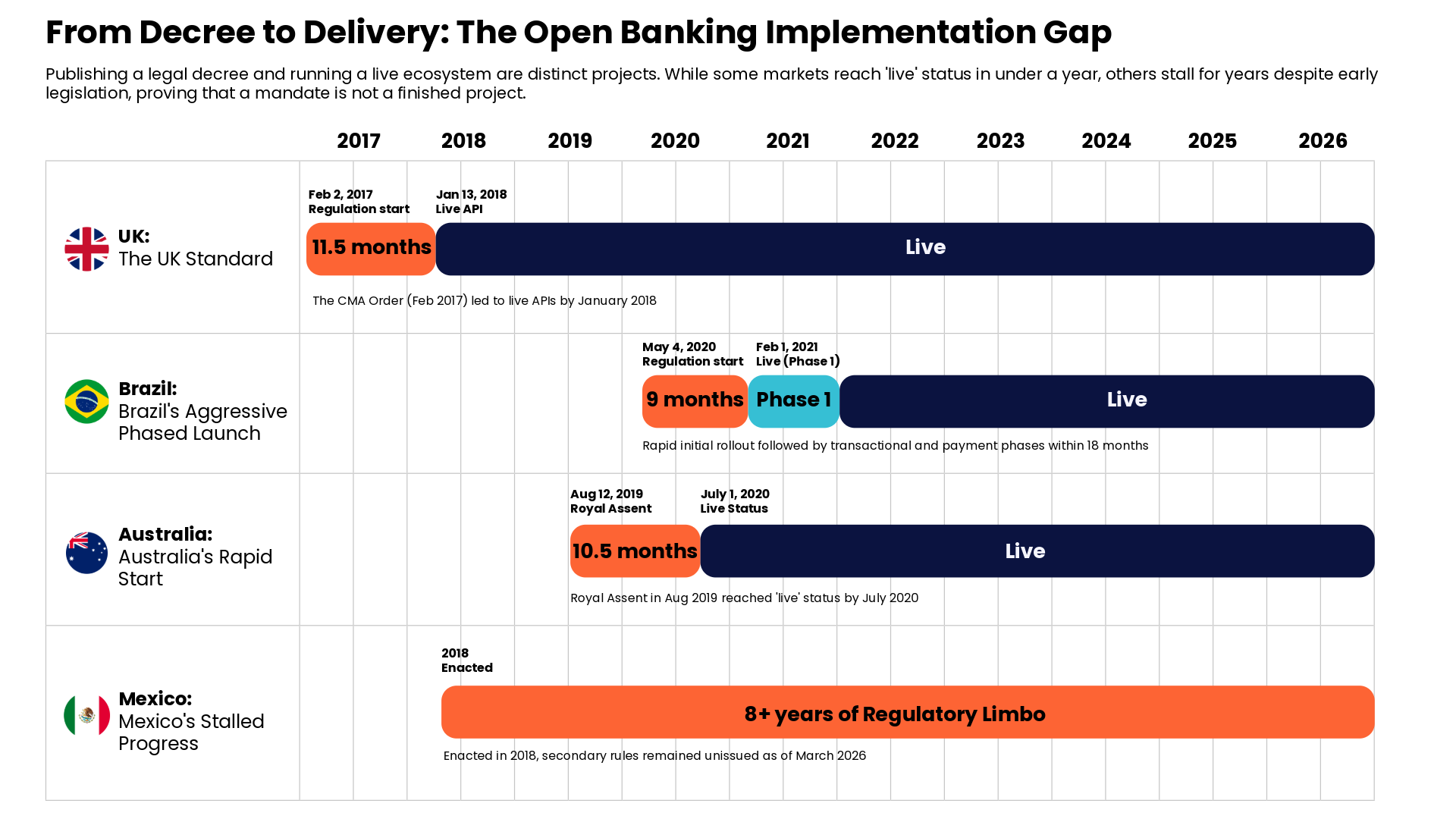
How long does this actually take? Leveraging a specialist platform to deliver compliant open banking APIs that keep up to date with future changes to the regulations and standards (like Ozone API) is a much faster and lower cost route to comply. Publishing a decree and running a live ecosystem are two different projects, and the gap between them varies enormously by market:
UK: CMA Order mandating the CMA9 banks build APIs, 2 February 2017. First live Open Banking APIs to third parties, 13 January 2018, about 11.5 months later.
Brazil: Foundational regulation published 4 May 2020. Phase 1 institutional data live 1 February 2021 (about 9 months later); Phase 2 consented transactional data live 13 August 2021; Phase 3 payment initiation live 29 October 2021, pushed back from a planned 30 August 2021 at banks’ and fintechs’ own request over readiness.
Australia: CDR Act received Royal Assent 12 August 2019, with Big Four bank data-sharing live 1 July 2020, roughly 10.5 months later (Australian Treasury / ZDNet, 30 June 2020). A separate, industry-commissioned ABA/Accenture review from July 2024 later found CDR adoption “disappointingly low,” a caution worth naming even though it comes from a single, interested-party source.
Uruguay’s draft is closer in structure to Brazil’s than to Mexico’s: it pairs the data-ownership mandate with concrete API and consent requirements rather than leaving them for later. That’s the detail worth watching as secondary regulation is drafted.
4. Market Opportunities: Who Wins and How?
Industry Actor
The Big Opportunity
FinTechs & Startups
Rapid onboarding, instant credit analysis from historical bank data, lower customer acquisition cost.
SMEs & Merchants
Cheaper payment acceptance through A2A payments, faster access to working capital based on verified cash flow.
Incumbent Banks
Partnerships with agile tech firms, modernised internal API architecture, embedded financial products beyond their own apps.
Consumers
Single-app views across accounts, faster loan approvals, personalised financial planning.
For incumbent banks specifically, the opportunity is bigger than defense. Once the API layer exists, it can be turned into a product line rather than just a compliance cost, through premium APIs and embedded finance APIs. We go deeper on that shift in Commercialising Open Banking: A Practical Guide.
Key Takeaways & Next Steps
For Tech Teams: The reality is that open banking requires a set of capabilities that you are unlikely to have in your existing technology stack. That means delivering APIs that meet the specific market standards. Supporting the specific security requirements such as FAPI 2.0. Handling the fine grained consent management to ensure only the right customer authorised access to trusted TSPs and PISPs. Building this in house has been a complex and costly process for many banks that have tried it.
For Product Leaders: Open Finance is more than a compliance project, at least it should be. This is a moment that has the potential to transform the banking business model. How and where your customers engage with their accounts with you and how you partner with other technology platforms you use. Whether you embrace it strategically or not things will change. Product Managers should develop clear strategies to determine how the open banking APIs can enable deeper partnerships with platforms their customers use. They should consider how the APIs can become a channel, not just to serve but to grow customers relationships (by embedding what you do, where your customers are). They also need to think how the payment landscape will change. Brazil’s Pix-via-Open-Finance volume went from 500k to 50 million million transactions in two years. That’s the kind of adoption curve that rewards whoever is ready to move first, not only whoever moves best.
For Compliance & Risk Officers: For Compliance and Risk officers the big consideration is ensuring your organisation complies and meets the regulatory obligations within the timescales. Whilst we have seen regulators show understanding in different markets, we have also seen them apply corrective measures and actions where banks miss their obligations. But also this is not a one off implementation. In all markets we have seen multiple phases of open finance bringing extensions to scope and functionality as well as new versions of standards. In fact conformance testing and certification has been mandated in a number of markets. Fundamentally though, open finance changes the business model for banking, enabling customers to provide consent to trusted third parties to access their data or make payments on their behalf, creating new considerations. It is a complex and ever changing area and requires expertise.
The Bottom Line
Uruguay is moving from isolated financial islands to a connected, API-first ecosystem, and the institutions that treat data as a customer asset rather than a proprietary fortress will lead the next wave of Latin American financial innovation. Uruguay is a mature market, with high levels of financial inclusion – top of class in Latin America – and the ideal environment for financial innovation to be created, tested, and readied for export and scaling to other markets.
We’ve watched this exact rollout happen in the UK, Brazil, Colombia, and now Uruguay, because we’ve helped build the standards-compliant API infrastructure behind several of them. That’s the work Ozone API does for PAIs and TPS operators navigating exactly this kind of mandate, across the standards we support globally. If your team is starting to map what BCU compliance means for your architecture, that’s a conversation worth having early.
Fundamentally, this is complex and requires a set of technical capabilities and expertise that typically do not exist in banks pre open finance.
Talking to experts early can really help you shape your plan, understand what is required and shape budgets. We’ve done this for banks around the world. Get in touch to find out how we can help.
Open banking revenue models are the commercial frameworks banks use to generate income from their open banking infrastructure, beyond the regulated minimum of free API access for licensed third parties. Regulation sets the foundation. What a bank builds above that base, and how it prices it, is what determines whether open banking becomes a cost...
Los bancos argentinos llevaban tiempo esperando saber qué les exigiría concretamente el esquema de Finanzas Abiertas (Open Finance). Esa espera concluyó con la emisión del Decreto 353/2025 en mayo de 2025. En la práctica, este decreto ubica a la Argentina en la misma senda regulatoria que los regímenes de Open Banking a nivel internacional. Aunque...
The Next Phase of KSA Open Banking Under the leadership of the Saudi Central Bank (SAMA), the Kingdom of Saudi Arabia continues to advance its Open Banking Framework as a core component of Vision 2030’s digital transformation agenda. Following the rollout of Account Information Services (AIS), the market is entering its next critical evolution: Payment...

 Phoebe Singer